Close
Since 2012, Park Hotel Tokyo’s “Artist in Hotel” project has invited artists to transform guest rooms into unique “Artist Rooms,” offering guests an immersive art experience. The 13th room to be completed was “Cherry Blossoms,” created by the Japanese artist Hiroko Otake. In this interview, Otake reflects on the stories behind the work, the themes she explored, and the thoughts she wove into the room.
Q. You usually create on flat surfaces such as canvas, so taking on an entire guestroom as a single work must have been a major challenge. What considerations or difficulties did you encounter in “painting the room itself” while being conscious of the space?
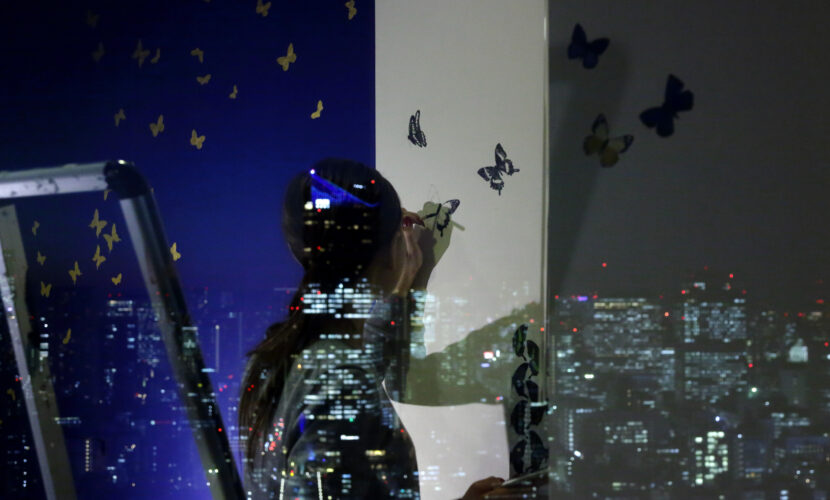
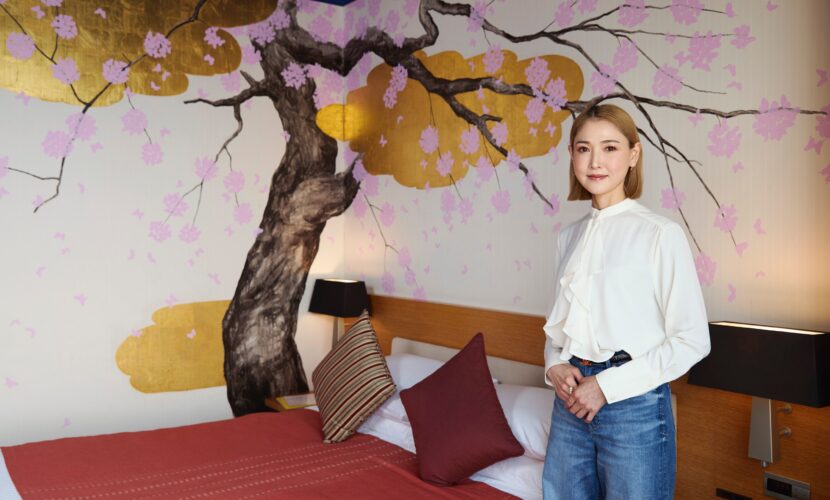
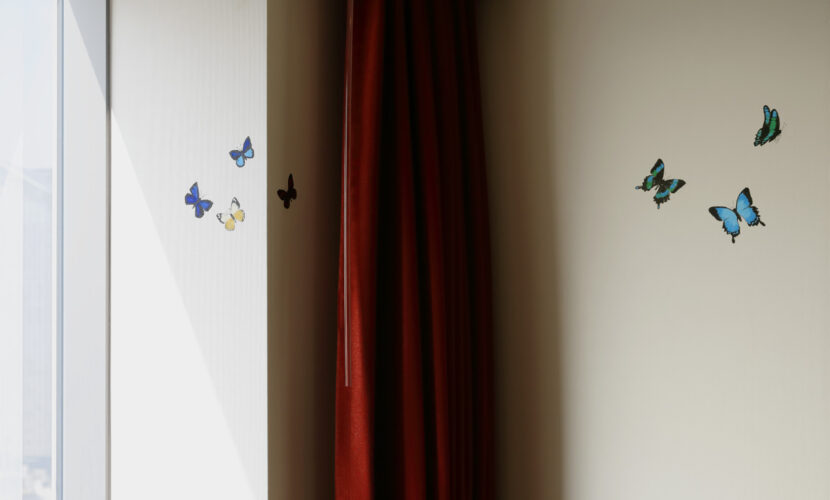
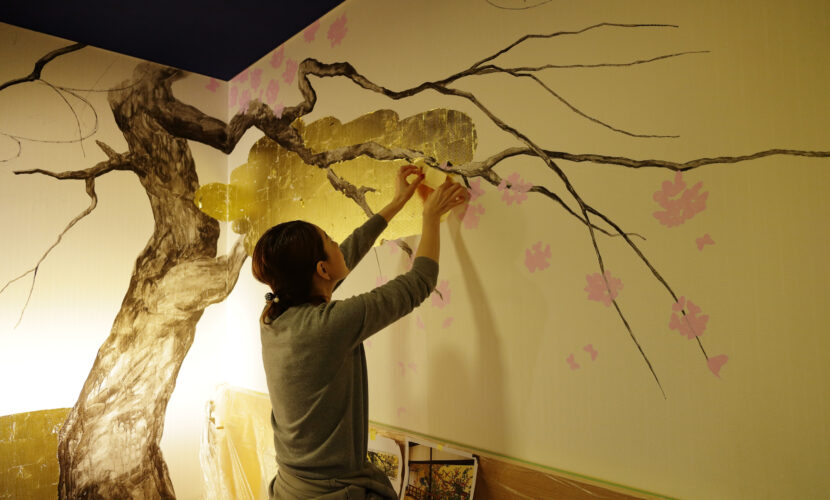
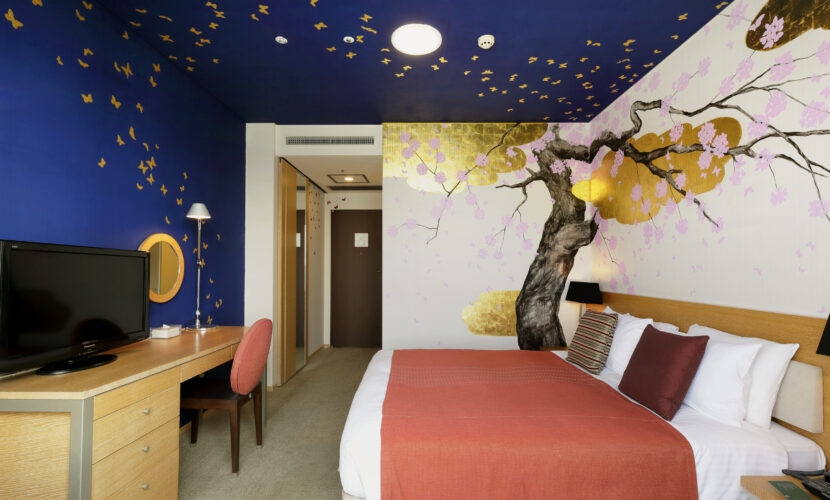
A.In Nihonga there is a tradition called shōheki-ga—large-scale paintings on architectural surfaces such as fusuma (paper sliding doors) and byōbu (folding screens)—which developed from the Momoyama period (1573–1603) into the early Edo period (from 1603). Exemplars include Nijō Castle (Kyoto). Until I was commissioned to create an Artist Room ten years ago, I had never had the opportunity to paint on such a large, spatial format. Being able to use the corners of the walls and even the ceiling with abandon became a precious experience—one in which I reinterpreted traditional shōheki-ga through a contemporary sensibility. On the technical side, there were many challenges. I usually work with iwa-enogu (mineral pigments) used in Nihonga, and because the particles are heavy, I paint on a horizontal surface, guiding the pigments into place and letting them dry completely before setting the work upright. On vertical walls, however, the paint would run, so for this project I used acrylic gouache. For gold leaf, the conventional dōsa sizing is not suitable for walls, so I used a special adhesive—one new experiment after another. As for the cherry blossoms, I was strongly inspired by Sakurazu by Kyūzō, the son of Hasegawa Tōhaku. Simply rendering cherry blossom in a contemporary manner didn’t feel compelling to me, so I conceived every petal as a butterfly. At first glance they appear to be cherry petals, but on closer look they are butterflies. I embedded this playful device so that guests might discover it during their stay and enjoy that moment of realization.
Q. Indeed, butterflies appear frequently in your work. You’ve said they symbolize “beauty and truth within ephemerality.” What led you to choose the butterfly as a motif in the first place?
A.The butterfly holds multiple meanings for me, but a major source of inspiration is Zhuangzi’s “Butterfly Dream.” In the tale, Zhuangzi becomes a butterfly in a dream, and upon waking cannot tell whether he is Zhuangzi who dreamed of being a butterfly, or a butterfly dreaming of being Zhuangzi. Whether in dream or reality, “I am who I am.” The world is not singular—two frameworks can exist simultaneously. This way of thinking is deeply connected to my artistic concept.
In this Artist Room, I explored the theme of “duality,” such as “dream and reality” and “parallel timelines.” In museums, one rarely looks up at the ceiling, but in a hotel you naturally look upward when lying in bed. In that moment, don’t the butterflies painted on the ceiling feel as if they are fluttering in a dream? I painted the lower walls as the “real world” and the ceiling as the “dream world,” expressing the coexistence of these two realms. I would be delighted if guests, upon looking up, could experience an immersive sensation—as though the butterflies were inviting them into the world of dreams.
Q. While the butterfly symbolizes moving between dream and reality, the work also expresses two different temporalities: the “ephemerality” of falling blossoms and the “cycle of the seasons” depicted throughout the room. Did you consciously address time in this way?
A.Yes, and I’m glad you perceived it that way. “The fleeting beauty of Cherry Blossom” and “the perpetual cycle of the seasons”—the coexistence of these opposing times within a single space lies at the heart of this room’s worldview and concept.The beauty of what is transient and the resilience of what endures—I focused on how to express that contrast within one room.
Q. You also used genuine gold leaf. What was your intention?
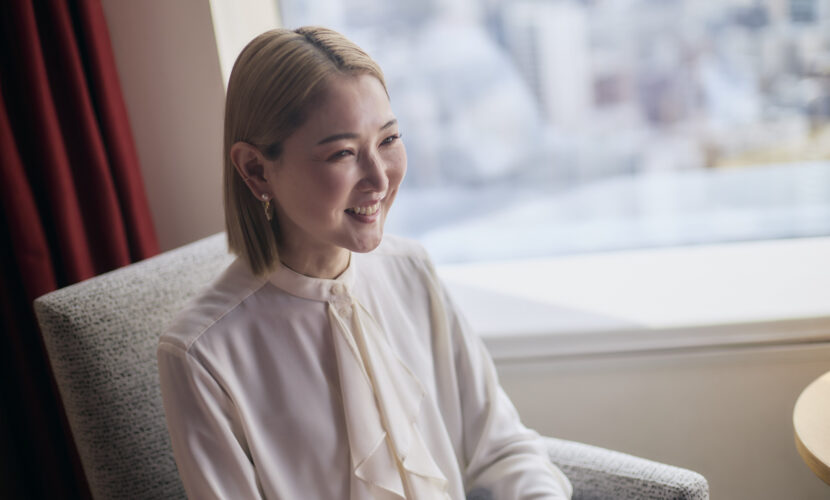
A.Gold leaf brings light into a space and brightens the entire room. At night, the cityscape outside reflects on the gold leaf, creating an even more dreamlike atmosphere—that’s part of its allure.Contemporary Nihonga painter Hiroko Otake, smiling as she speaks about the challenges of the creation process. In the Momoyama period (1573–1603), gold leaf was also used to introduce light into dim interiors, and I wished to carry that tradition forward in a contemporary setting. Moreover, as a material, gold hardly changes—making it a symbol of “eternity.” I chose gold leaf to create a contrast with the transience of cherry blossom, a choice that resonates deeply with the room’s theme.
Q. Your work reflects a Japanese sense of beauty shaped by impermanence; in creating this room, which aspects of Japanese culture—or which figures or ideas—most influenced you?
A. As I mentioned, I’ve been greatly influenced by Hasegawa Tōhaku’s folding screens. In addition, Maruyama Ōkyo’s byōbu work “Hyozu” (Ice) left a profound impression on me. He depicts ice solely with lines, achieving something both realistic and abstract. With minimal strokes, one can feel that “cold air.” This expression also resonates with the Minimalism that flourished in postwar America. The fact that such “contemporary” modes were achieved in the Edo period moves me deeply. It is one of the works that prompted me to pursue Nihonga. I find it truly compelling how “Hyozu” builds a world from the fewest possible brushstrokes.
Q. You created the work over a one-month stay at Park Hotel Tokyo. Did the process of “painting while staying in the hotel” lead to any discoveries?
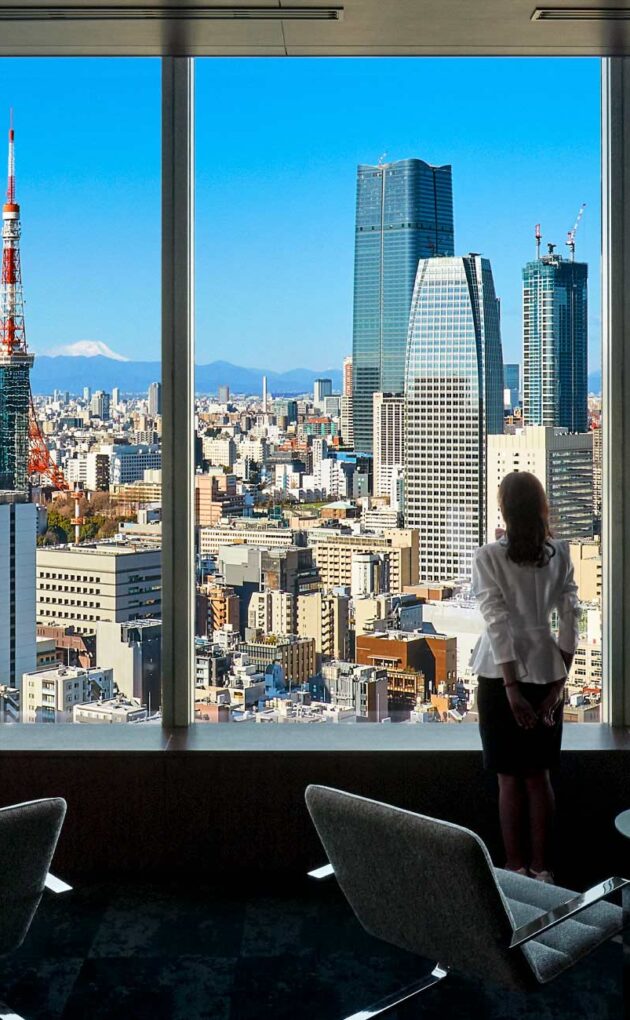
A. I was truly grateful for an environment where I could devote myself to creating every day. From the room I could see Tokyo Tower and even Mt. Fuji, and the twilight sky changed moment by moment with such beauty. The passage of time is a major theme of this work, so painting while witnessing those shifts firsthand was invaluable. When I finished, we held a small party with people who had been creating nearby—it’s a memory I cherish.
Q. More than 95 percent of Park Hotel Tokyo’s guests are from overseas. What kind of experience would you like international visitors to have at the hotel?
Q. It has been nearly ten years since you created Artist Room “Cherry Blossom.” Has your perception of the work changed over time?
A.Back then I worked entirely on my own, and it was physically demanding. Looking back, I feel a fond amazement that I “carried it through.” Remembering how I donned goggles and workwear each day to paint the ceiling brings back the vigor and intensity of that time. As the years pass, it’s those struggles and hard-won moments that come to mind first.
Q. Lastly, do you have a message for guests staying in Artist Room “Cherry Blossom”?
A.This room is a space that traces time and the changing seasons, with cherry Blossom as its starting point. The butterfly is also a symbol of “transformation” and “renewal,” and that intention suffuses the entire room. I would be delighted if the time you spend here resonates with the memories and senses within you, allowing you to enjoy a calm and enriching moment.
Staff Comment:
Completed ten years ago, “Cherry Blossom” remains one of our most popular Artist Rooms. At first glance it is gorgeous—the quintessential Japanese scene of cherry blossoms continues to delight our overseas guests. In speaking with Ms. Otake, we were struck by the interplay of opposites throughout: “dream and reality,” “the transience of cherry blossom and the enduring cycle of the seasons,” “day and night.” Her signature motif—the butterfly—freely traverses those realms and invites us into her worldview. The discovery that the cherry petals are, in fact, butterflies reveals a playful spirit at the heart of contemporary art.
Inspired by Hasegawa Tōhaku’s folding screens and Maruyama Ōkyo’s “Hyozu,” Ms. Otake began her journey in NihongA. Artist Room “Cherry Blossom,” which fuses traditional techniques with a contemporary sensibility, is truly “a spatiotemporal experience where the Japanese aesthetic can be felt firsthand.” We hope you will enjoy a wonderful stay.
ー Discover more about the world of Cherry Blossoms